
I've been fasting for 25 years. I didn't start because a study told me to. I started because I felt better doing it — sharper, leaner, more in control. But the longer I've lived this way, the more the science has caught up to confirm what my body already knew: intermittent fasting and longevity are deeply, mechanistically connected. This isn't a wellness trend. It's a biological instruction that's been hardwired into us for a very long time.
Most people come to fasting wanting to lose weight. That's fine — it works for that. But if weight loss is the only reason you're here, you're underselling yourself. The real prize is what fasting does to the machinery underneath: the cellular cleanup, the hormonal recalibration, the metabolic flexibility that separates people who age gracefully from people who fall apart at 60. This post is about that bigger picture.
The Core Longevity Mechanisms Behind Intermittent Fasting
When scientists study organisms that live exceptionally long — from nematodes to humans — a few biological pathways keep showing up. Fasting activates nearly all of them. Here's what's actually happening when you skip breakfast.
Autophagy: Your Body's Self-Cleaning Protocol
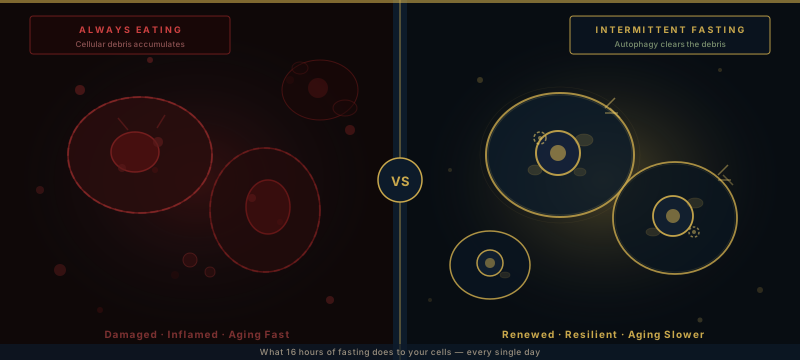
Autophagy — from the Greek for "self-eating" — is the process by which your cells identify damaged proteins, dysfunctional organelles, and cellular debris and dismantle them for parts. Think of it as your body's internal recycling and quality-control system. When this process runs efficiently, you age better. When it's chronically suppressed — which happens when you're always eating — cellular garbage accumulates, and that accumulation is implicated in everything from neurodegenerative disease to cancer.
Fasting is the most reliable way to upregulate autophagy. The research on this earned Yoshinori Ohsumi the 2016 Nobel Prize in Medicine. A 16-hour fast initiates it. Longer fasts — 24 to 36 hours — accelerate it significantly. This is one reason I've kept the extended fast as a cornerstone of the Fast & Feast method for years: it's not punishment, it's maintenance.
mTOR Suppression: The Anti-Aging Switch
mTOR (mechanistic target of rapamycin) is a master regulator of cell growth and metabolism. When mTOR is chronically activated — which happens when you're constantly eating, especially protein and carbohydrates — the body stays in build mode and never shifts to repair mode. High mTOR activity is associated with accelerated aging and increased cancer risk.
Fasting suppresses mTOR. This signals the body to slow growth, ramp up cellular repair, and prioritize longevity pathways over anabolic ones. The balance isn't about always suppressing mTOR — you need it for muscle growth and recovery — but about cycling between states. That's exactly what intermittent fasting creates: regular, deliberate periods where mTOR quiets down and repair takes over.
What the Research Actually Says About Fasting and Lifespan
Animal studies have shown fasting-related caloric restriction extending lifespan by 30–40% in rodents. Human studies can't run that long, but the proxy markers are compelling. Intermittent fasting improves insulin sensitivity, reduces chronic inflammation, lowers oxidative stress, and favorably alters gene expression patterns associated with longevity. These aren't minor tweaks — they address the core drivers of age-related disease.
A 2019 study published in Cell Metabolism showed that time-restricted eating (the formal term for what most people call intermittent fasting) improved blood pressure, insulin levels, and oxidative stress markers even without caloric restriction. A 2022 review in Nature Aging concluded that fasting-related dietary patterns consistently activate the same longevity pathways as caloric restriction — with far better adherence rates.
The longevity math is simple: You need roughly 12–14 hours of fasting to deplete liver glycogen and shift into fat-burning mode. You need 16+ hours to meaningfully upregulate autophagy. You need 24–36 hours to trigger deeper cellular repair and the kind of mTOR suppression associated with longevity research.
The 16:8 protocol gets you there daily. The weekly extended fast takes you further. Together, they're not a diet — they're a biological maintenance schedule.
Fasting Duration & Longevity Pathways Activated
Key longevity pathways activated at each fasting milestone
Metabolic Flexibility — The Longevity Skill Nobody Talks About
Here's something that doesn't get nearly enough attention in the longevity conversation: metabolic flexibility — the ability to efficiently switch between burning glucose and burning fat — is one of the strongest predictors of long-term health. Chronically inflexible metabolism (the kind that develops from constant eating and constant carbohydrate availability) correlates with insulin resistance, obesity, cognitive decline, and cardiovascular disease.
Intermittent fasting trains metabolic flexibility by design. Every fasting window forces your body to find alternative fuel. Over weeks and months, this makes the transition seamless. I can go 20, 24, 36 hours without food and function at a high level — not because I'm torturing myself, but because my metabolism knows exactly what to do. That adaptability isn't just convenient. It's a marker of biological resilience that translates directly to how well you age.
How to Fast Specifically for Longevity
If your goal is longevity — not just weight loss — a few specific practices move the needle more than others.
Prioritize the 16-hour minimum daily. This is non-negotiable for autophagy initiation. The 16:8 window isn't just convenient, it's the threshold where the longevity mechanisms actually engage. Going to 18:6 or 20:4 periodically accelerates the effect.
Add a weekly extended fast. The 36-hour Monk Fast is the protocol I've used for years. One extended fast per week produces cellular cleanup that daily 16-hour fasts alone can't replicate. Think of the daily fast as maintenance and the weekly extended fast as the deep clean.
Manage your feast window as carefully as your fast. Longevity fasting isn't a license to eat whatever you want during your eating window. Whole foods, adequate protein, healthy fats, and minimal processed sugar give your cellular repair systems the right building materials to work with. The fast creates the conditions; the feast determines the quality of the rebuild.
Don't fear hunger — reframe it. The mild hunger you feel during a fast is autophagy at work. Your body is consuming old cellular material for fuel. That uncomfortable feeling is your cells getting a tune-up. In 25 years, I've come to think of it as the sensation of my body doing its job.
The Complete Fast & Feast System
The book covers the full longevity protocol — daily fasting windows, the weekly extended fast, feast-day nutrition, and how to build a lifestyle that actually compounds over time.
Get the BookIntermittent Fasting and Longevity: The Long Game
There's no shortage of people selling you shortcuts to a longer life — supplements, peptides, cold plunges, red light panels. Some of it has merit. Most of it is expensive noise. Intermittent fasting is the one intervention that is free, has 25 years of subjective validation in my own body, and is backed by some of the most compelling mechanistic science in modern biology. It's not glamorous. You just stop eating for a while, regularly, for the rest of your life. But the cellular machinery it activates — autophagy, mTOR regulation, metabolic flexibility, insulin sensitivity — addresses aging at its root. That's not a small thing. That might be everything.
Free Download
Get the Fast & Feast Starter Guide
The 7-day jumpstart plan, fasting schedules, and feast-day meal ideas — delivered instantly.
Frequently Asked Questions About Intermittent Fasting and Longevity
Does intermittent fasting really increase longevity?
Research consistently shows that intermittent fasting activates key longevity pathways — autophagy, mTOR suppression, and improved insulin sensitivity — all of which are strongly associated with extended healthspan in both animal and human studies. While long-term human lifespan studies are difficult to run, the mechanistic evidence is compelling and the proxy markers are hard to dismiss.
How long do you need to fast to trigger autophagy?
Autophagy begins to upregulate after approximately 14–16 hours of fasting. A consistent 16:8 protocol initiates it daily. Extended fasts of 24–36 hours produce significantly greater autophagy activation and deeper cellular repair — which is why the weekly extended fast is such a powerful complement to the daily protocol.
What is mTOR and why does fasting suppress it?
mTOR (mechanistic target of rapamycin) is a master cellular signaling pathway controlling growth and metabolism. Chronically high mTOR — which results from constant eating — accelerates aging and suppresses repair. Fasting suppresses mTOR, shifting the body from growth mode to maintenance mode. This cycling is central to why fasting is one of the most studied interventions in longevity research.
Is a 16:8 fast enough for longevity benefits, or do I need longer fasts?
Daily 16:8 fasting provides meaningful longevity benefits — consistent autophagy initiation, improved insulin sensitivity, and metabolic flexibility. A weekly extended fast of 24–36 hours amplifies these effects in ways that daily fasting alone cannot replicate. Think of the daily fast as the maintenance protocol and the extended fast as the scheduled overhaul.
Does what I eat during my eating window affect longevity?
Significantly. The fast creates the repair conditions; the feast provides the building materials. Whole foods, adequate protein, and minimal processed sugar support the longevity mechanisms fasting activates. Poor nutrition during the eating window undermines the cellular repair the fast works to initiate — the two halves of the protocol work together.