If you're a woman and fasting isn't working for you — it's not your fault. You've been following a plan designed for men. Not metaphorically. Literally. The vast majority of intermittent fasting research was conducted on male subjects. The guidelines that got handed down to women were extrapolated from male data — and in the cases where they did test women, they often tested female rats.
Not women. Rats.
And here's the problem with that: a rat's entire reproductive cycle runs in four to five days. Their hormonal response to fasting is dramatically more volatile than a human woman's. Translating rodent fasting data directly to human women is like using Chihuahua nutrition guidelines to feed a Great Dane. The biology doesn't transfer — and yet that's exactly what happened. For decades.
The result? Women were told fasting was dangerous for their hormones. That their cycles would go haywire. That they should stick to 12 hours maximum. That men could fast aggressively but women needed to be careful.
Every single one of those claims falls apart when you look at actual human clinical trials.
Here's what the real science says — and then the cycle-syncing protocol that transforms fasting from something women are warned against into the most powerful metabolic tool in their arsenal.
Intermittent Fasting for Women: The Myths — And What Science Actually Shows
"Intermittent fasting disrupts women's hormones."
A landmark study led by Dr. Krista Varady, professor of nutrition at the University of Illinois Chicago, found that intermittent fasting did not change estrogen, gonadotropins, or prolactin levels in women. The researchers specifically designed the study to address the rodent-based fear-mongering — and found it didn't hold up in human clinical trials. One hormone, DHEA, showed a modest decrease — but remained within the normal range throughout the study.
"Fasting causes irregular periods and fertility problems in women."
Menstrual disruption is caused by chronic caloric restriction — not fasting itself. If you fast and then under-eat during your eating window, your body will eventually respond. But intermittent fasting where you eat adequate nutrition during your feast window has not been shown to disrupt menstrual cycles in healthy women. In fact, for women with PCOS — a condition that affects up to 15% of women of reproductive age — fasting has shown remarkable promise: reducing testosterone, lowering the free androgen index, and improving menstrual regularity and fertility markers.
"Women should stick to shorter fasts — 12 hours maximum."
The "12 hours maximum" guideline was never based on robust human clinical evidence. It was a precautionary recommendation extrapolated from incomplete data. The real nuance is timing, not duration. Women who fast in alignment with their hormonal cycle — longer fasts during the follicular phase, shorter windows during the late luteal phase — can safely and effectively do 16:8, 18:6, and yes, even extended 36-hour fasts. The key is working with your cycle, not ignoring it.
"Fasting will make women lose muscle and tank their metabolism."
Human Growth Hormone spikes by up to 500% during a 36-hour fast — in both men and women. HGH is the primary hormone responsible for preserving lean muscle mass. Research consistently shows that people lose the same amount of lean mass whether they fast or follow a standard calorie-restricted diet. The metabolism-slowing fear is equally unfounded: studies show that short-term fasting actually increases metabolic rate by 3.6–14% through norepinephrine elevation. Your body is not trying to starve itself — it's trying to survive, and fasting activates every survival-optimization mechanism it has.
Why Women Are Actually Built for Fasting
Here's the part nobody tells you: in some ways, women are better suited to fasting than men.
Women generally have higher fat oxidation rates — meaning their bodies are more efficient at switching to fat burning during a fast. Estrogen, when it's elevated during the follicular phase, acts as a powerful metabolic enhancer: it improves insulin sensitivity, lowers the cortisol stress response, and makes the fasted state smoother and easier to sustain. Women in the follicular phase often report that fasting feels almost effortless — and now we know why.
The male body is hormonally consistent day-to-day. The female body is cyclical — four distinct hormonal environments across the month. That cyclical nature isn't a weakness. It's a built-in optimization schedule, if you know how to read it.
That's exactly what cycle syncing is.
Cycle Syncing & Intermittent Fasting: Your Month-by-Month Protocol
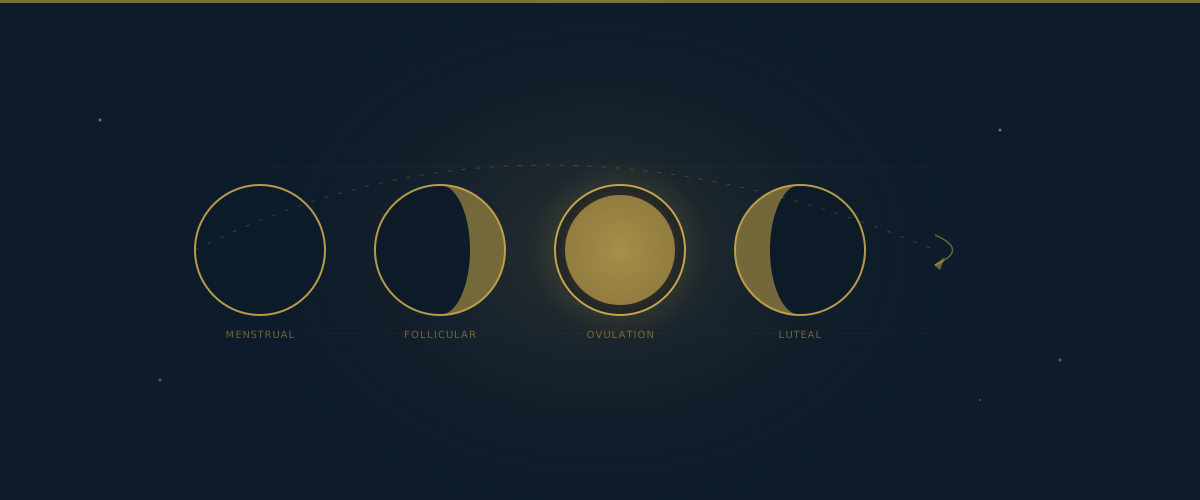
Your menstrual cycle has four phases, each creating a different hormonal environment. Here's how to align your fasting practice with each one:
Your Monthly Fasting Map
Rest & restore
Push your limits
Moderate
Scale back
Where the 36-hour fast fits for women: Schedule your longer fast during the follicular phase — roughly days 7–12 of your cycle, after your period ends and before ovulation. This is when your hormonal environment most closely mirrors the conditions under which extended fasting delivers its deepest benefits: peak estrogen, excellent insulin sensitivity, naturally lower appetite, and the most resilient stress response. The God Mode window (hours 24–36) feels noticeably more accessible during this phase.
What to Eat During Your Feast Window — By Phase
The feast window is where cycle syncing gets even more powerful. Your nutritional needs shift with your hormones, and feeding your body the right things at the right time amplifies everything fasting does.
During your menstrual phase, prioritize iron replacement (dark leafy greens, legumes, red meat), anti-inflammatory foods (turmeric, ginger, berries), and magnesium to ease cramping (dark chocolate, pumpkin seeds, spinach).
During your follicular phase, lean into gut-supportive foods that amplify the autophagy benefits of your longer fasts: fermented foods like kimchi and sauerkraut, cruciferous vegetables for estrogen metabolism support, and high-quality proteins for the repair work your cells are doing.
During your ovulatory phase, shift toward higher protein and reduce refined carbohydrates as insulin sensitivity begins to wane. Anti-inflammatory fats — salmon, avocado, olive oil — support the hormonal transition gracefully.
During your luteal phase, your body genuinely needs more complex carbohydrates — not because you failed, but because progesterone demands them. Chickpeas, bananas, beans, sweet potatoes, and calcium-rich foods will work with your hormones rather than against them. This is the phase where fighting hunger backfires hardest.
What About Perimenopause and Menopause?
As cycles become irregular or stop altogether, the phase-by-phase approach becomes less structured — but the core principle remains: listen to your body's hormonal signals, not a rigid clock.
For perimenopausal women, the fluctuating hormones of the transition mean some weeks will feel like follicular phase ease and others will feel like late luteal phase difficulty. Track how you feel during fasts and adjust accordingly — the data your body gives you is more reliable than any generic protocol.
For post-menopausal women, the hormonal cyclicity is gone, but the benefits of fasting remain fully intact — and in many cases amplified. Without the progesterone-driven appetite increases of the luteal phase, many post-menopausal women find that a consistent 16:8 or even 36-hour weekly fast becomes easier and more sustainable than it ever was during their cycling years. Studies show fasting is particularly effective for reducing visceral fat and improving insulin sensitivity in post-menopausal women.
How to Start Cycle Syncing Intermittent Fasting: By Experience Level
Here's exactly what to do tomorrow, based on where you are right now:
Why One-Size-Fits-All Fasting Fails Women
The real enemy isn't fasting — it's the one-size-fits-all approach that was never designed with your biology in mind. When women try to follow a static fasting protocol built for male physiology, here's what happens:
- Fasting too aggressively in the luteal phase spikes cortisol and amplifies PMS symptoms
- Ignoring hunger cues during progesterone-dominant phases creates a stress response that tanks sleep and mood
- Following the same window every day means you're fasting against your hormones half the month
- Getting poor results and blaming yourself — when the protocol was the problem all along
The Fast & Feast system was built differently. It's a flexible, cyclical approach that gives you a structured framework — the five-phase weekly protocol — that you layer on top of your monthly cycle. Extended fasting when your biology supports it. Rest and nourishment when it doesn't. You stop fighting your body and start working with it.
That's the system. It took 25 years to develop. The book has everything.
Free Download
Get the Fast & Feast Starter Guide
The 7-day jumpstart plan, fasting schedules, and feast-day meal ideas — delivered instantly.
The Complete System — Built for Real Life
The Fast & Feast Ultimate Lifestyle covers every phase of the weekly cycle — Pre-Fast, Fast, Re-Seed, Re-Feed, and Maintenance — with protocols, meal guidance, and the science behind every decision. 25 years of living it, documented.
Get the BookFrequently Asked Questions
Is intermittent fasting safe for women?
Yes — for healthy adult women, the evidence strongly supports intermittent fasting as safe and beneficial. Human clinical trials found that fasting does not negatively affect estrogen, gonadotropins, or prolactin. The hormone disruption fears originated from rodent studies that don't translate to human physiology. Women with PCOS may actually benefit most from fasting due to its effect on testosterone and insulin.
What is cycle syncing for intermittent fasting?
Cycle syncing means adjusting your fasting windows to match the four phases of your menstrual cycle. Longer fasts during the follicular phase (days 6–14) work with your biology. Shorter windows during the late luteal phase (days 22–28) prevent cortisol spikes that can disrupt hormonal balance. The goal is not to fast less — it's to fast smarter.
Should women do 16:8 differently than men?
The core protocol can be similar, but women benefit from adjusting intensity across the month rather than keeping it rigidly the same every day. During the follicular phase, women can fast as aggressively as — or more aggressively than — men. During the late luteal phase, scaling back to 12–14 hours is the smarter move. The one-size-fits-all approach was largely designed around male physiology.
Can women do a 36-hour fast?
Yes — and the ideal time is during the follicular phase (roughly days 6–14), when estrogen is rising, insulin sensitivity is at its peak, and your body's stress response is naturally lower. This is when the 36-hour fast delivers its deepest benefits — peak autophagy, HGH optimization, and God Mode cognitive clarity — with the least disruption to your hormonal rhythm.
Does fasting affect the menstrual cycle?
Excessive chronic caloric restriction can disrupt menstrual cycles — but this is a calorie deficit issue, not a fasting issue. Intermittent fasting where adequate nutrition is consumed during the eating window has not been shown to disrupt menstrual cycles in healthy women in human clinical trials. The key is ensuring your feast window is genuinely nourishing, especially during the luteal phase.