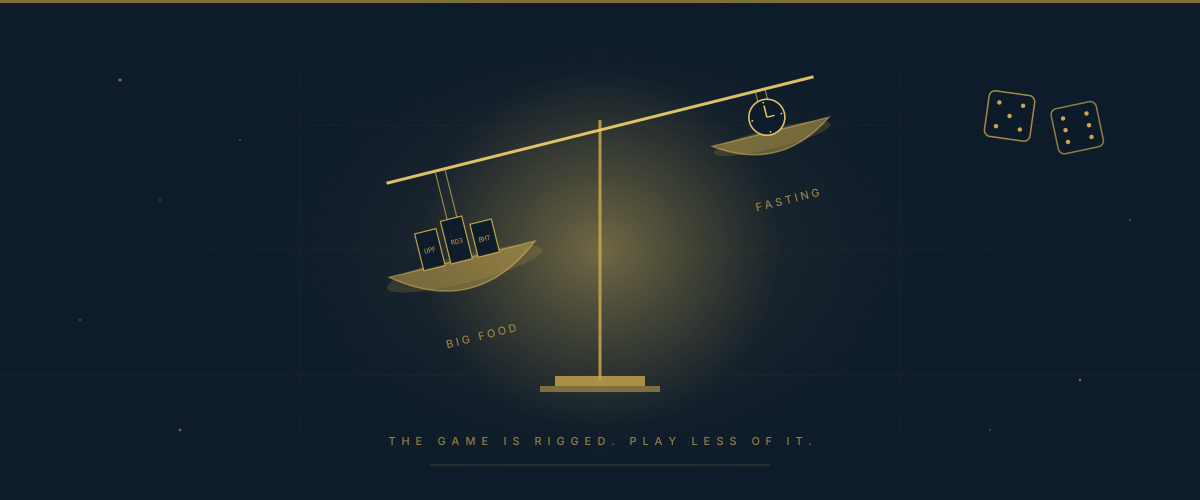
Every morning the game starts before your feet hit the floor. You unlock your phone and the first three ads are for cereal, fast food, and a "healthy" snack bar that has thirty-eight ingredients and a cartoon cheetah on the box. You walk into a gas station and there are twelve thousand calories of color-coded plastic between you and the bottle of water you came in for. Welcome to the game. The game is rigged.
I have been watching this game for twenty-five years. It does not get less rigged. It gets cleverer. The packaging got prettier. The buzzwords got friendlier. "Plant-based." "Natural flavor." "Made with real fruit." Meanwhile the actual food got worse, the additives got weirder, and the chronic disease numbers kept climbing.
Here is the part nobody on a billboard will tell you: you cannot lose a game you do not play. You also cannot opt out forever. Nobody is moving to a wheat field in Switzerland. So the question becomes how much of this game you choose to participate in, and what you do with the hours you spend not playing. That is where fasting walks in and quietly flips the table.
Watch · The Game Is Rigged
Two minutes on the rigged game, and the one move that takes you out of it.
The Game (and Why It Was Built to Beat You)
Let us not pretend any of this is an accident. Big Food and Big Ag are not surprised that a country eating roughly sixty percent of its calories from ultra-processed food is also the sickest developed country on earth. They built the menu. They wrote the marketing. They bankrolled the studies. They lobbied the agencies that were supposed to be protecting you. The game is operating exactly as designed.
Roughly sixty percent of the average American's daily calories now come from ultra-processed foods. That is not a snack. That is most of what people eat. And the science on what that does to a human body has stopped being a debate. C-reactive protein climbs. Gut microbiome collapses. Insulin resistance creeps in. Cardiovascular risk goes up. Cancer risk goes up. Mental health worsens. More than a hundred prospective studies say the same thing in slightly different words: stop eating this stuff and people get healthier.
Here is what makes the game especially American. Many of the ingredients in your pantry are not just unhealthy. They are illegal in other countries. Take a stroll through a UK grocery store and try to find Red Dye No. 40 in a children's cereal. You will not. Try to find titanium dioxide in your candy in Italy. They banned it in 2022. BHT in your crackers? The EU said no thanks years ago. The American food supply is a chemistry experiment that the rest of the world quietly bowed out of.
A Quick Tour of the "Allowed in America" Aisle
- Red Dye No. 3, finally banned by the FDA in 2025, with a generous two-year runway for manufacturers to keep selling the stuff until 2027.
- Six other synthetic dyes, scheduled for phaseout by the end of 2026 (a date that has a polite habit of getting pushed back the way last year's marketing deadline did).
- Titanium dioxide, banned in EU food in 2022. Still legal here in your gum, your candy, and a surprising amount of your salad dressing.
- BHT and BHA, antioxidants that extend shelf life and possibly mess with your endocrine system, still living comfortably in plenty of American cereals and crackers.
- Potassium bromate, banned in the UK, EU, Canada, and Brazil. Still allowed in U.S. bread, because nothing says American breakfast like a flour conditioner three other continents quit.
If you read that list and felt vaguely ill, congratulations. That is your nervous system working correctly.
The Marketing Is Worse Than the Ingredients
You can almost respect honest junk food. A bag of Doritos has the decency to look you in the eye. It is not pretending to be quinoa. Where the game gets dirty is the middle aisle of the grocery store, where products with thirty-eight ingredients show up wearing wellness costumes and charging eight dollars for the privilege.
This year, the Texas Attorney General opened an investigation into Kellogg's, accusing the company of marketing products as healthy while still loading them with the artificial dyes the company itself promised to remove back in 2018. Eight years late. The Tony the Tiger version of "the check is in the mail."
This is the playbook. Promise to remove the bad stuff. Slap a green leaf on the box. Raise the price by twenty percent for the "natural" line. Change nothing meaningful. Run out the clock until everyone forgets. Then do it again with the next ingredient. Rinse, sweeten, repeat.
The House Always Wins (Until You Stop Playing)
The first three bars are theirs. The fourth one is yours, every single day.
You Cannot Lose a Game You Do Not Play
Here is the move nobody in the food industry wants you to make. Stop eating, on a schedule, for part of every day. Not crash dieting. Not white-knuckle restriction. Just eat in a window and do not eat outside of it.
The minute you start fasting, three things happen at the same time. Your insulin drops. Your body shifts to burning stored fat. And every single hour you are not eating is an hour Big Food cannot sell to you. That last one is the part that should be on a billboard, and never will be.
Fasting is the only food protocol I know of that the supplement aisle cannot capture. There is no fasting flavor of cereal. There is no fasting bar. The product is "nothing," and "nothing" has a marketing budget of zero. Which is exactly why it works, and exactly why you will never see it advertised next to the football game.
The Math of Sitting Out:
Eight hours of eating per day means sixteen hours of not buying anything.
Sixteen hours per day is roughly two thirds of your life off the menu.
Stretch one fast a week to thirty-six hours, and you have just removed an entire day of being a customer.
That is not a diet. That is a quiet refusal to play, repeated every week, for the rest of your life.
This Is Not About Being Pure. It Is About Owning the Hours.
Let me be clear about something. I am not telling you to move to the woods, churn your own butter, and never eat a Snickers again. I have been on this lifestyle for twenty-five years and I still walk into bakeries on three continents and eat the warm croissant. Life is good. The croissant is part of the goodness. (My wife will confirm this in court if needed.)
But the goodness only works because most of the time, I am not playing. Most of the time my body is in a fasted state, doing the cellular cleanup, burning fat, resetting insulin, and not absorbing whatever the food industry decided to put on the shelf this year. The croissant lands on a body that is metabolically free, not metabolically captured.
That is the whole game. Not perfection. Possession of your own hours. You do not have to defeat Big Food. You only have to be a worse customer than they were counting on.
How to Refuse to Play (Starting This Week)
If you are new to this, do not start with a 36-hour fast and a green smoothie ritual. Start with the move that costs you nothing and asks for almost no willpower.
- Pick a 14-hour overnight window for two weeks. Last bite by 8 p.m., first bite at 10 a.m. That is it. That is the entire assignment.
- Drink water and black coffee in the morning. The fewer ingredients on the label of what you put in your body, the less of the game you are playing.
- One day a week, push to a 16- or 18-hour fast. See how it feels. Most people are surprised. Hunger is a wave, not a wall.
- Spend your eating window on food that has fewer than five ingredients you can pronounce. If a fifth grader cannot read the box, your liver should not be expected to either.
- Read one ingredient label per day for a week. You will start unprompted boycotts you did not know you had in you.
That is week one. By week three you will start noticing things. Sleep gets cleaner. Cravings get quieter. The grocery store starts to look less like a pantry and more like a casino, where every aisle has a slot machine pretending to be food.
Free Download
Get the Fast & Feast Starter Guide
The 7-day jumpstart plan, fasting schedules, and feast-day meal ideas, delivered instantly.
The Strategy Behind the Refusal
The Fast & Feast Ultimate Lifestyle book is the full playbook for stepping out of the rigged game without becoming weird about it. 16:8, the 36-hour Monk Fast, what to eat when you do eat, how to travel through it, and how to keep this thing working for the next thirty years. Twenty-five years of practice, written for adults who are tired of being a target market.
Get the BookThe food companies are not going to lose this fight on their own. They are too big, too rich, and too good at what they do. But they do not have to lose, because that was never the assignment. The assignment is yours. Fewer hours playing. More hours fasting. Less of the box. More of the body.
You cannot lose a game you do not play. So play less of it. Starting tomorrow morning. The system will keep running just fine without you. You just do not have to keep buying tickets.
Frequently Asked Questions: Big Food, Fasting, and the Rigged Game
Is fasting really powerful enough to push back against a poor food environment?
Yes, and it is one of the few tools that works without requiring you to win a fight you cannot win. Fasting lowers insulin, restores insulin sensitivity, triggers autophagy (your body's cellular cleanup process), and reduces systemic inflammation. None of that requires perfect food. It just requires hours when you are not eating. That alone is a massive correction in a food environment where most people graze from sunrise to bedtime.
What about all the vitamins and minerals in fortified processed foods?
Most of those nutrients are added back in after processing strips them out, often in synthetic forms your body absorbs poorly. You are paying for the privilege of eating something that was nutritionally robbed and then handed back a bus pass. Real food (eggs, fish, vegetables, fruit, meat) delivers bioavailable nutrients in the matrix your body actually evolved to absorb. The fortified box is marketing dressed up as nutrition.
If I just buy organic and read labels, isn't that enough?
It helps a lot, and you should do it. But cleaner inputs are still inputs. The body needs hours of not eating to do its repair work. You can eat organic strawberries every two hours all day and your insulin will still be high and your fat-burning systems will still be off. Clean food plus a fasting window is the combination. One without the other is half the protocol.
How long until I notice a difference once I stop playing the game?
For most people, ten to fourteen days. The first week is mostly recalibration: sleep changes, cravings settle, the morning hunger that felt non-negotiable starts to fade. By the second week, energy stabilizes and focus improves. By month three you are a different person on labs, with inflammation markers down, fasting insulin down, and body composition shifting. The game does not unrig overnight. It unrigs faster than you think.
Will skipping breakfast really make me healthier than eating 'a balanced breakfast'?
The 'most important meal of the day' line was written by a cereal company. Literally. It was a marketing slogan, not a nutrition principle. Plenty of historically healthy populations did not eat first thing in the morning. Pushing your first meal to 10 or 11 a.m. is one of the easiest, lowest-friction ways to extend your fasting window. If you train hard early in the morning, you may want to eat sooner. If you sit at a desk, you almost certainly do not.