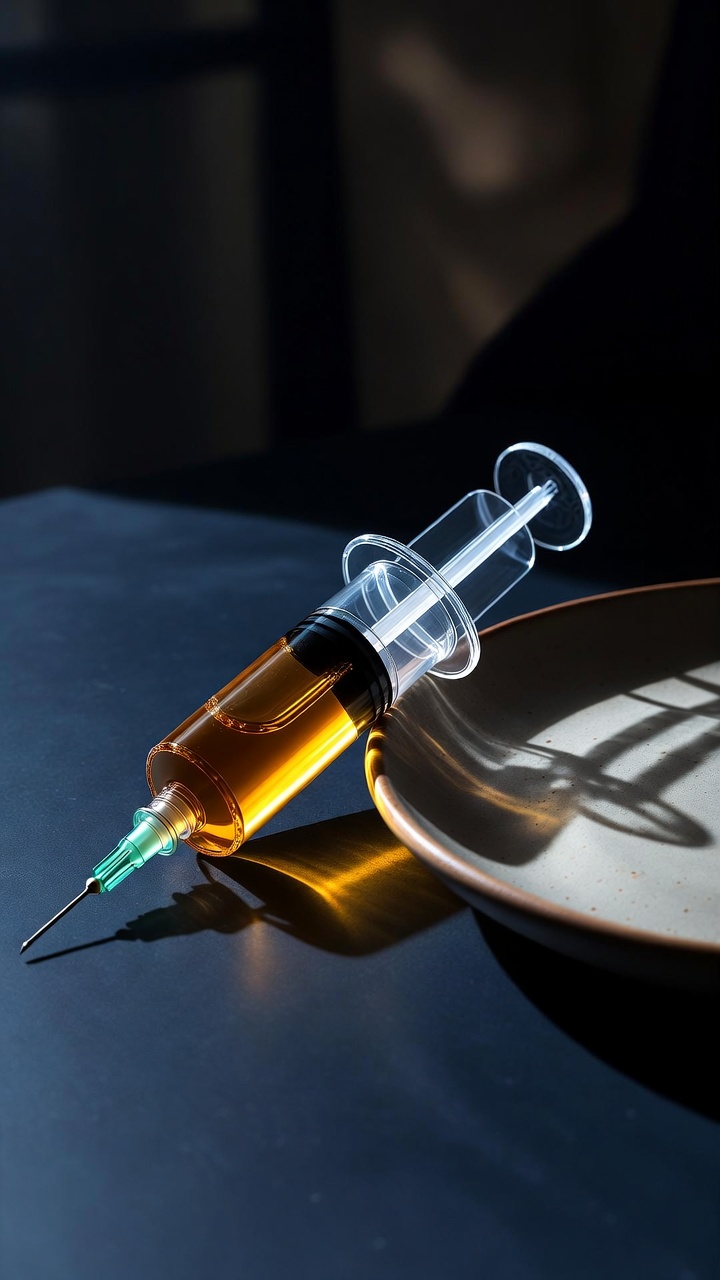
A weekly injection that suppresses appetite, triggers fat burning, improves insulin sensitivity, and produces dramatic weight loss. The pharmaceutical industry calls it a breakthrough. Wall Street calls it a $50 billion market. Your doctor calls it semaglutide. Everyone else calls it Ozempic.
I've been doing the same thing for 25 years. I call it Tuesday.
I'm not here to tell you Ozempic doesn't work. It does. The clinical trial data is real, the weight loss is real, and for people with serious metabolic disease, it may be genuinely life-changing. I respect that.
What I'm here to do is ask a question that nobody with a pharmaceutical check seems interested in asking: Why are millions of people paying $300 to $1,349 a month for a drug that mimics something their body knows how to do naturally — and has known how to do since before we invented breakfast?
What Ozempic Actually Does
Semaglutide — the active ingredient in Ozempic and Wegovy — is a GLP-1 receptor agonist. GLP-1 (glucagon-like peptide-1) is a hormone your body naturally produces in the gut after eating. It signals your brain to stop being hungry, slows the rate at which your stomach empties, triggers insulin release to manage blood sugar, and reduces the amount of glucagon (a fat-storing hormone) circulating in your blood.
Ozempic is a synthetic mimic of this hormone, engineered to last longer in your bloodstream than the real thing. The result: your brain is chemically told to stop being hungry. Your appetite drops. You eat less. You lose weight.
That's it. That's the mechanism. It's not magic. It's appetite suppression through hormonal override.

The $1,349-a-month weekly ritual. There's another way.
What Fasting Does
Now let's talk about what happens when you simply stop eating for 16, 24, or 36 hours.
Within 12 hours, your insulin levels drop as glucose is depleted. Your body starts producing ketones — molecules derived from fat that your brain actually prefers as fuel once it gets access to them. Ghrelin, the hunger hormone, initially spikes around your normal mealtimes — and then, notably, drops below baseline as ketosis deepens. Your appetite doesn't just quiet down. After the first few fasts, it restructures.
By hour 16–24: deep fat oxidation. Human Growth Hormone spikes up to 500% — your body's primary lean muscle preservation signal. Autophagy activates, the cellular cleanup mechanism that earned Yoshinori Ohsumi a Nobel Prize. Blood pressure drops. Inflammatory markers fall. Insulin sensitivity — the same metric Ozempic improves — improves measurably.
By hour 24–36 (what I call God Mode): you are running almost entirely on ketones. Your brain is operating on a fuel source it almost never gets in the modern world. Cognitive clarity that has to be experienced to be understood. Emotional flatness — not depression, more like peace. The hunger is gone. You are not suffering. You are thriving.
And you didn't inject anything.
Side by Side: The Numbers That Matter

One costs $1,349 a month. The other costs nothing. Both lead to the same place.
| Ozempic / Wegovy | Intermittent Fasting | |
|---|---|---|
| Monthly cost | $149–$1,349 | $0 |
| Appetite suppression | Yes (chemical) | Yes (ketones/adaptive) |
| Fat burning | Yes (indirect) | Yes (direct ketosis) |
| Insulin sensitivity | Improves | Improves |
| Muscle loss risk | 20–30% of weight lost is lean mass | HGH spikes 500% — preserves muscle |
| Common side effects | Nausea (38%), diarrhea (9%), fatigue | Hunger (adapts), temporary fatigue |
| Autophagy / cellular repair | No | Yes — Nobel Prize-winning mechanism |
| Works when you stop | No — weight regain begins within 8 weeks | Yes — metabolic flexibility is a trained skill |
| Requires a prescription | Yes | No |
The Part Nobody Tells You: What Happens When You Stop
This is where the Ozempic story gets uncomfortable.
The STEP 1 clinical trial — the landmark study that launched Wegovy's FDA approval — included an extension phase. Researchers tracked participants after they stopped taking the drug. One year later, they had regained two-thirds of their prior weight loss. Not a little. Not some. Two-thirds.
A January 2026 study from the University of Oxford confirmed what the STEP 1 extension suggested: stopping GLP-1 weight loss drugs leads to faster weight regain than ending a structured diet program. The drug doesn't teach your body anything. It just overrides your appetite until the moment you stop paying for it to do so.
The Ozempic Bill — What You're Actually Paying For
Let me be precise about what that data means. If you lose 20 pounds on Ozempic, 4–6 of those pounds were muscle. Stop taking the drug and you gain 13 pounds back within a year — but not the muscle. You've ended up lighter on paper, weaker in reality, and you're now on a drug indefinitely or facing an uphill metabolic battle.
Compare that to fasting. When your body burns fat during a fast, HGH ensures muscle is protected. The weight you lose is overwhelmingly fat. And unlike a chemical override, metabolic flexibility is a skill your body learns. After a year of consistent fasting, your appetite genuinely normalizes. The hunger that felt intolerable in week one becomes background noise by month six. You are not renting the result. You are building it.
Twenty-Five Years. No Prescription Required.
I started intermittent fasting in 2001. One 36-hour fast per week, every week, without exception. Over 1,300 consecutive fasts. My weight has stayed within a 5-pound range for two and a half decades. My appetite is genuinely different than it was before I started — not suppressed by a drug, but recalibrated by repetition. My body knows how to fast. It's a skill now, not a struggle.
I'm 25 years into the result Ozempic is promising you. I didn't need a prescription. I didn't need an injection. I needed to understand what my body was already capable of — and a protocol simple enough to actually do for life.
That's what the Fast & Feast system is. Not a diet. Not a drug. A practice.
A Fair Word in Ozempic's Defense
I want to be honest here, because this isn't a hit piece.
For people with severe obesity, type 2 diabetes, or metabolic disease so advanced that lifestyle intervention alone hasn't worked, GLP-1 medications represent a genuine medical tool. The cardiovascular data on semaglutide is real. For some patients, the risk of inaction is higher than the risk of long-term drug use. That's a legitimate clinical calculus.
What I object to is the marketing — the suggestion that a $1,349-a-month drug is the only or obvious solution for people who are 20 pounds overweight and have never seriously tried fasting. The suggestion that your body needs pharmaceutical intervention to do what it evolved to do naturally. The silence about the rebound data. The silence about the muscle loss data. The silence about the free alternative sitting right there, waiting.
You deserve to know what your body can do before you decide to outsource it.
Free Download
Get the Fast & Feast Starter Guide
The 7-day jumpstart plan, fasting schedules, and feast-day meal ideas — delivered instantly.
The System That Does This for Free
The Fast & Feast protocol — one 36-hour fast per week, every week — achieves everything GLP-1 drugs promise, plus autophagy, plus cognitive clarity, plus a permanent shift in how your metabolism works. 25 years of proof. No prescription required.
Get the BookFrequently Asked Questions
Can you combine Ozempic with intermittent fasting?
Yes — and the combination has been studied. GLP-1 medications and intermittent fasting work through complementary mechanisms, and the appetite suppression from the drug can make the fasting window easier to maintain. However, the overlap in appetite suppression means people can easily under-eat, and muscle loss becomes a significant risk without adequate protein and resistance training. If you're on a GLP-1 medication and considering fasting, discuss it with your prescribing physician.
Does fasting raise GLP-1 naturally?
GLP-1 is primarily released by the gut in response to food intake — so fasting doesn't trigger it in the same way Ozempic mimics it. What fasting does is achieve the same downstream outcomes through different mechanisms: appetite drops through ketone production reducing ghrelin, insulin sensitivity improves as glucose is depleted, and fat burning activates as your primary fuel source. The end result looks the same. The pathway is different — and owned by you, not a pharmaceutical company.
Why do people regain weight after stopping Ozempic?
Because Ozempic overrides your appetite signal without addressing why it was dysregulated. The STEP 1 trial extension found two-thirds of prior weight loss was regained within a year of stopping. A January 2026 Oxford study confirmed faster regain than ending a structured diet. When the drug stops, your original hormonal environment returns. Fasting, by contrast, trains your body's metabolic flexibility over time — the result compounds rather than evaporates.
Does Ozempic cause muscle loss?
Approximately 20–30% of weight lost with semaglutide comes from lean body mass, not fat. This is comparable to or slightly better than diet and exercise alone for similar weight loss — but meaningfully worse than extended fasting, which triggers a 500% spike in Human Growth Hormone specifically designed to protect muscle during caloric deficit. Body composition outcomes between the two approaches are not equivalent.
Is fasting better than Ozempic for weight loss?
Short-term clinical weight loss: Ozempic wins, particularly for people with metabolic disease. Long-term, permanent metabolic change: fasting wins. The difference is that fasting builds a skill — metabolic flexibility — that your body retains and improves upon. Ozempic produces a rented result that disappears when the prescription stops. After 25 years of fasting, I eat what I want during my feast windows and my weight has not changed by more than 5 pounds in two decades. No drug achieves that.